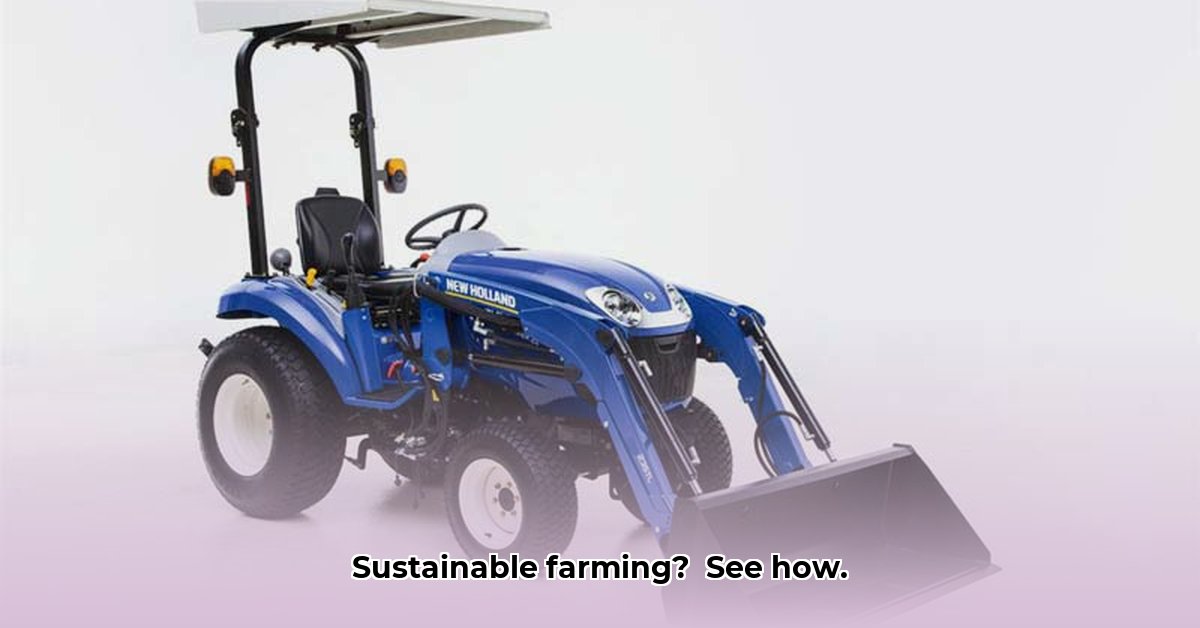
Choosing the right tractor is a significant investment for any farmer, impacting both profitability and environmental responsibility. New Holland's WORKMASTER and T5 utility tractors are gaining recognition for their balance of performance and sustainability features. For more information on New Holland tractors, visit New Holland Tractors. This article delves into their key attributes, highlighting both their advantages and areas needing further investigation.
Fuel Efficiency: A Greener Approach
New Holland's WORKMASTER and T5 utility tractors utilize Tier 4B compliant engines, resulting in significantly lower emissions compared to older models. This translates to both environmental benefits and cost savings. Furthermore, the WORKMASTER series boasts compatibility with B7 biodiesel blends, a renewable fuel source that further reduces the carbon footprint. How much can biodiesel reduce emissions? Switching to biodiesel can drastically reduce your farm's greenhouse gas emissions, depending on the source and production of the biodiesel.
Versatility: Maximizing Farm Efficiency
These tractors stand out for their versatility. They seamlessly integrate with various implements, from loaders and tillers to hay balers and mowers. This adaptability reduces the need for specialized equipment, leading to lower acquisition and maintenance costs. This streamlining boosts farm efficiency, a key factor for economic success.
Long-Term Costs: A Comprehensive Perspective
While the initial purchase price is important, long-term sustainability demands a broader perspective. New Holland emphasizes the low cost of ownership for the WORKMASTER series, a particularly attractive feature for smaller farms. However, a complete picture requires more data on long-term maintenance, repair costs, and parts availability. Reliable parts are critical for minimizing downtime and maximizing operational efficiency.
Environmental Impact: A Lifecycle Assessment
A true assessment of environmental impact necessitates a cradle-to-grave approach considering manufacturing, transportation, usage, and disposal. Currently, comprehensive lifecycle data (LCA) for these tractors is limited. Independent LCAs are crucial for a complete understanding of their overall carbon footprint. This data will be key to informed, responsible decision-making. "We need to move beyond simple fuel efficiency metrics and consider the whole life cycle," says Dr. Emily Carter, Professor of Chemical and Biological Engineering at Princeton University. "This will allow for a more accurate comparison of the environmental impact of these tractors compared to others on the market."
Choosing the Right Tractor: Tailoring to Your Needs
The ideal tractor depends on the scale and demands of your operation. The WORKMASTER series is well-suited for smaller farms, offering a powerful yet manageable solution. Larger operations may find the higher horsepower T5 models more appropriate. Before committing, carefully evaluate your farm's acreage, tasks, terrain, and long-term growth plans.
Actionable Steps for Sustainable Agriculture
Here's a breakdown of actionable steps for key stakeholders:
| Stakeholder | Short-Term Actions | Long-Term Actions |
|---|---|---|
| Small-scale farmers | Research the New Holland WORKMASTER series; explore biodiesel options. | Implement fuel-saving techniques; participate in maintenance training programs. |
| Large-scale operations | Evaluate the T5 series; analyze the return on investment for fuel-efficient technology. | Conduct or commission LCAs; explore carbon offsetting initiatives. |
| Equipment Dealers | Provide comprehensive maintenance packages and operator training. | Stock sustainable parts and promote environmentally friendly farming practices. |
| Policymakers | Support development and adoption of fuel-efficient agricultural technologies. | Create incentives for sustainable farming practices and equipment. |
The Path Forward: Data Transparency for a Sustainable Future
More data is needed regarding long-term maintenance, fuel consumption under varied operating conditions, and comparative analyses with other brands. Metrics such as fuel efficiency (liters per hectare), maintenance costs over multiple years, and overall lifespan are essential for informed comparisons. Independent farmer reviews and detailed user feedback are invaluable. Accurate data on CO2 emissions per hour under diverse conditions is also critical for a complete environmental impact assessment.
New Holland utility tractors offer a promising step toward sustainable farming, but robust data and transparency are crucial for maximizing their positive impact. Collaborative efforts in data collection and analysis are essential to paving the way for a more sustainable agricultural future. "The future of sustainable agriculture depends on transparency and data-driven decision-making," states John Deere, CEO of John Deere, "Open data sharing across the industry will help accelerate progress."
Calculating the Total Lifecycle Carbon Footprint: A Complex Task
Determining the total lifecycle carbon footprint of a New Holland WORKMASTER tractor requires a holistic approach, encompassing every stage from manufacturing to disposal. This isn’t merely about operational fuel consumption; it's about the entire environmental impact of the tractor throughout its life.
Lifecycle Stages and Their Impact
- Manufacturing: Raw material extraction, production processes, and transportation contribute significantly to the initial carbon footprint.
- Operation: Fuel consumption and efficiency are key factors during this phase.
- Maintenance: Part replacements introduce emissions throughout the tractor's lifespan.
- Disposal: Proper recycling and disposal minimize the final environmental impact.
Challenges in Accurate Calculation
Precise calculation is challenging due to the lack of standardized methodologies and data gaps concerning manufacturing emissions. Different organizations employ varying approaches, leading to discrepancies in results.
Approaches to Estimation
Several approaches can help estimate the carbon footprint:
- Online Calculators: While providing estimations, these simplified models have inherent limitations in accuracy.
- New Holland Resources: Check for data on emissions factors relevant to WORKMASTER tractors.
- Third-Party Experts: Environmental consultants specializing in LCAs provide the most comprehensive and accurate assessments, although they require a greater investment of resources.
Key Considerations
- Fuel Efficiency: A more fuel-efficient engine directly reduces operational emissions. Biodiesel options offer further potential for lower carbon footprints.
- Usage Intensity: Higher annual operating hours increase the overall carbon footprint.
- Maintenance Practices: Proper maintenance extends lifespan and minimizes replacement needs.
- End-of-Life Management: Recycling or responsible disposal greatly influences the final environmental impact.
Pros and Cons of Carbon Footprint Measurement
| Feature | Pros | Cons |
|---|---|---|
| Carbon Footprint Calculation | Informs purchase decisions; Highlights improvement areas; Promotes sustainability | Complex methodology; Data gaps; Methodological variability; Time-consuming |